--.--.--
Case File — Accessed
CardWise
Record 04 / 04
Justin Lee — CardWise · Stanford UX for AI
Record Open
--:--:-- Local
Case 04 / 04
Stanford UX for AI  ·  Capstone
Case Study  ·  AI Product

Card
Wise

An AI-powered credit card benefit optimizer that helps users stop leaving money on the table — without requiring financial expertise or manual tracking.

Designer
Justin Lee
Context
Stanford UX for AI — Capstone
Role
Research · Interaction Design · Prototyping
Methods
User Interviews · Survey · Lo-fi Wireframes
3
moderated user interviews with observed real-time behavior
10+
minutes per purchase decision for power users
$100s
in annual benefits lost to fragmentation and forgetting
Problem

Benefits exist. The system to use them doesn't.

Consumers hold multiple credit cards for the perks — but those perks are buried across issuer apps, emails, and fine print. The result: real money left unredeemed, every month.

Fragmented information

No participant had a single place to view all their benefits. Every check required jumping between 2–3 banking apps and navigating card-specific menus.

Complexity as a deterrent

Benefit terms are conditional, inconsistent, and frequently changing. Even motivated users defaulted to memorized rules rather than reading current terms.

Time cost kills engagement

High-engagement users spent 10+ minutes per purchase decision. Lower-engagement users gave up entirely, leaving the most valuable benefits unclaimed.

Confidence ≠ optimization

Users who felt confident in their card usage were often optimizing only one dimension — points or cashback — while ignoring credits, perks, and rotating categories.

"I have four cards in my wallet and I still don't know which one to use at the grocery store."
Research participant · CardWise discovery
Research

Who's actually losing money — and how

Three moderated interviews paired with a classmate survey. During interviews, participants attempted live benefit lookups — revealing friction invisible in self-reported data.

Power User

10+ cards, 3 banks

Checks every card before large purchases. Spends ~1 min per card, 10+ min total. Still misses rotating and conditional benefits despite high effort.

Points Optimizer

10+ cards, travel-focused

Reviews weekly, focuses on flights and hotels. Deep expertise in travel benefits — but other benefit categories go entirely unused.

Low Engagement

5 cards, 2 banks

Rarely checks. Relies on cashback categories memorized from signup. Navigation friction alone is enough to stop benefit exploration.

01

Fragmentation increases effort

No single view = repeated navigation = most users giving up before checking all cards.

02

Memory fails dynamic benefits

Mental models built at signup become stale. Rotating and conditional benefits are systematically missed.

03

Friction directly correlates with underuse

The harder the system is to navigate, the fewer benefits get redeemed — regardless of card quality.

04

Self-confidence masks gaps

Users who felt informed were often optimizing only one benefit dimension and unaware of what they were missing.

Interaction Design

Choosing the right AI interaction model

Financial decisions require both speed and trust. Three models were evaluated before selecting the approach that best balanced those needs.

Interface Agent

User speaks in natural language; AI interprets and acts. Fast and accessible, but opaque — users who want to compare alternatives have no visibility into the reasoning.

Direct Manipulation

Users control filters, rankings, and card views directly. Maximum transparency, but high cognitive load — less financially savvy users found this overwhelming.

Selected

Mixed Initiative

AI proactively surfaces recommendations; users retain final say and can adjust preferences at any point. Balances efficiency with trust — critical in financial contexts.

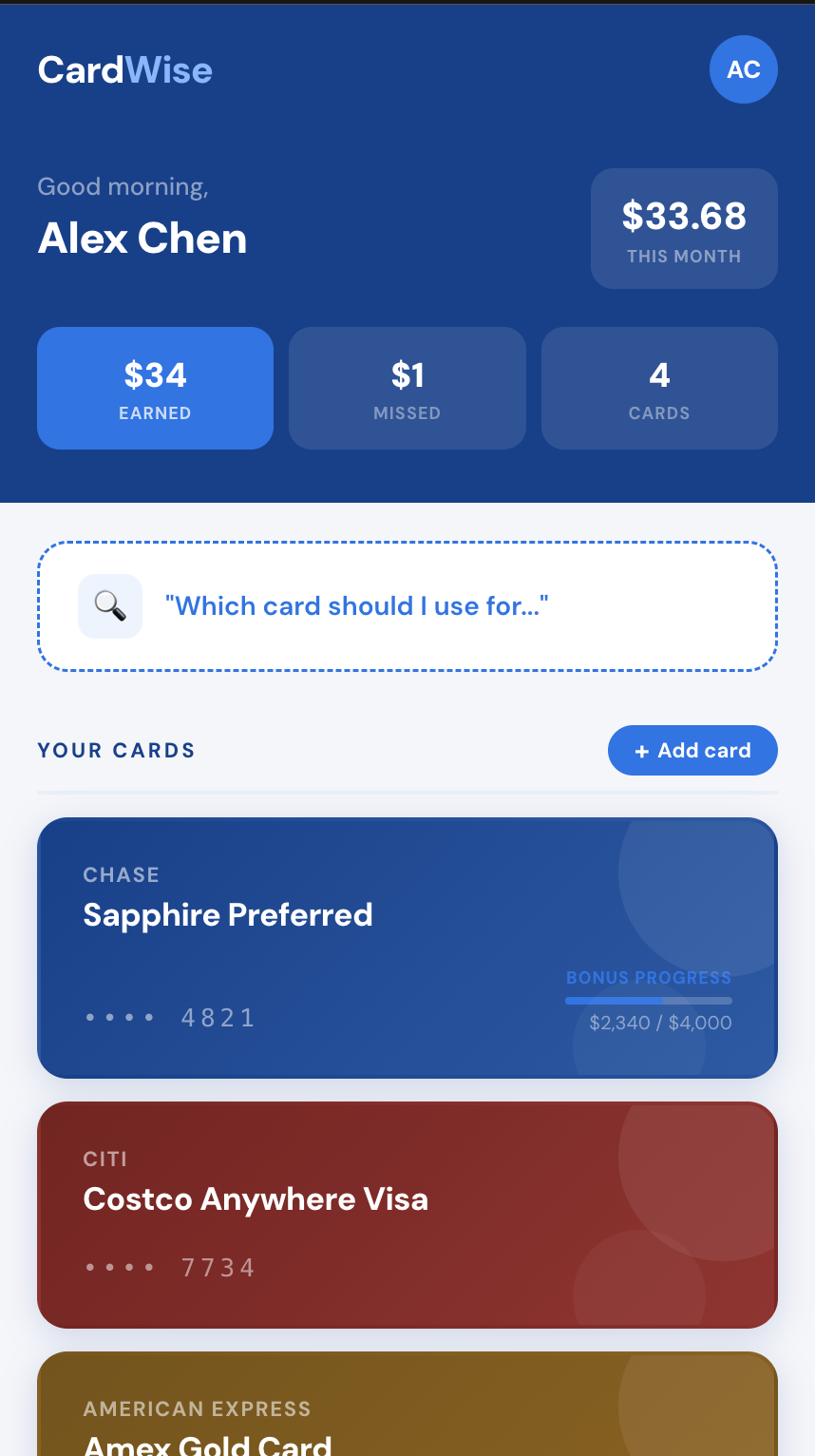
The final design also pulls from Direct Manipulation — a card gallery view lets users scan all options at a glance without needing to converse with the AI when they just want the data fast.

Lo-fi Wireframes

Voice Interface Agent
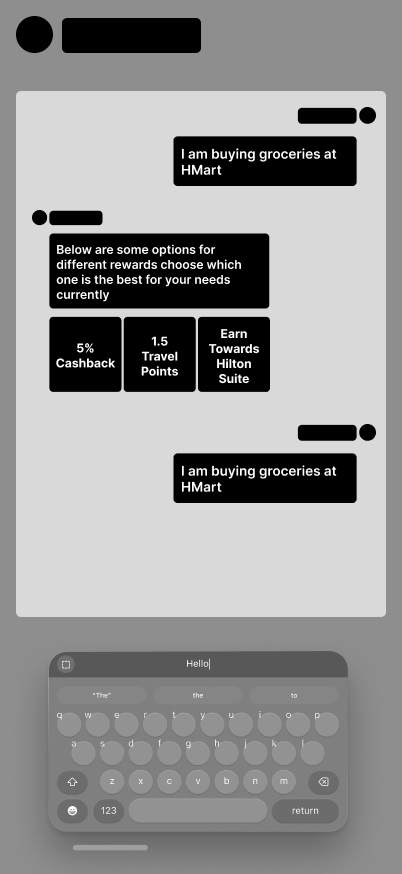
Mixed Initiative Interaction
Direct Manipulation Agent

Interface Agent wireframe
Mixed Initiative wireframe
Direct Manipulation wireframe
Design Decisions

What shaped the interface

Chatbot entry point
Embedded directly into the Chase banking app's homepage as a persistent "What are you looking for?" input — meeting users in the context where they already manage money, not requiring a separate app install.
Contextual benefit surfacing
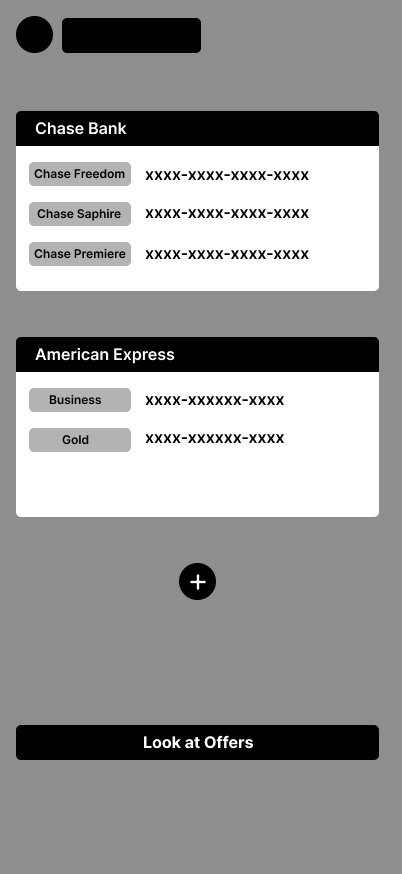
Benefits are grouped by card and presented with the current month's best offers first — not an exhaustive list. Reduces cognitive load at the moment of a purchase decision.
Goal-first recommendation flow
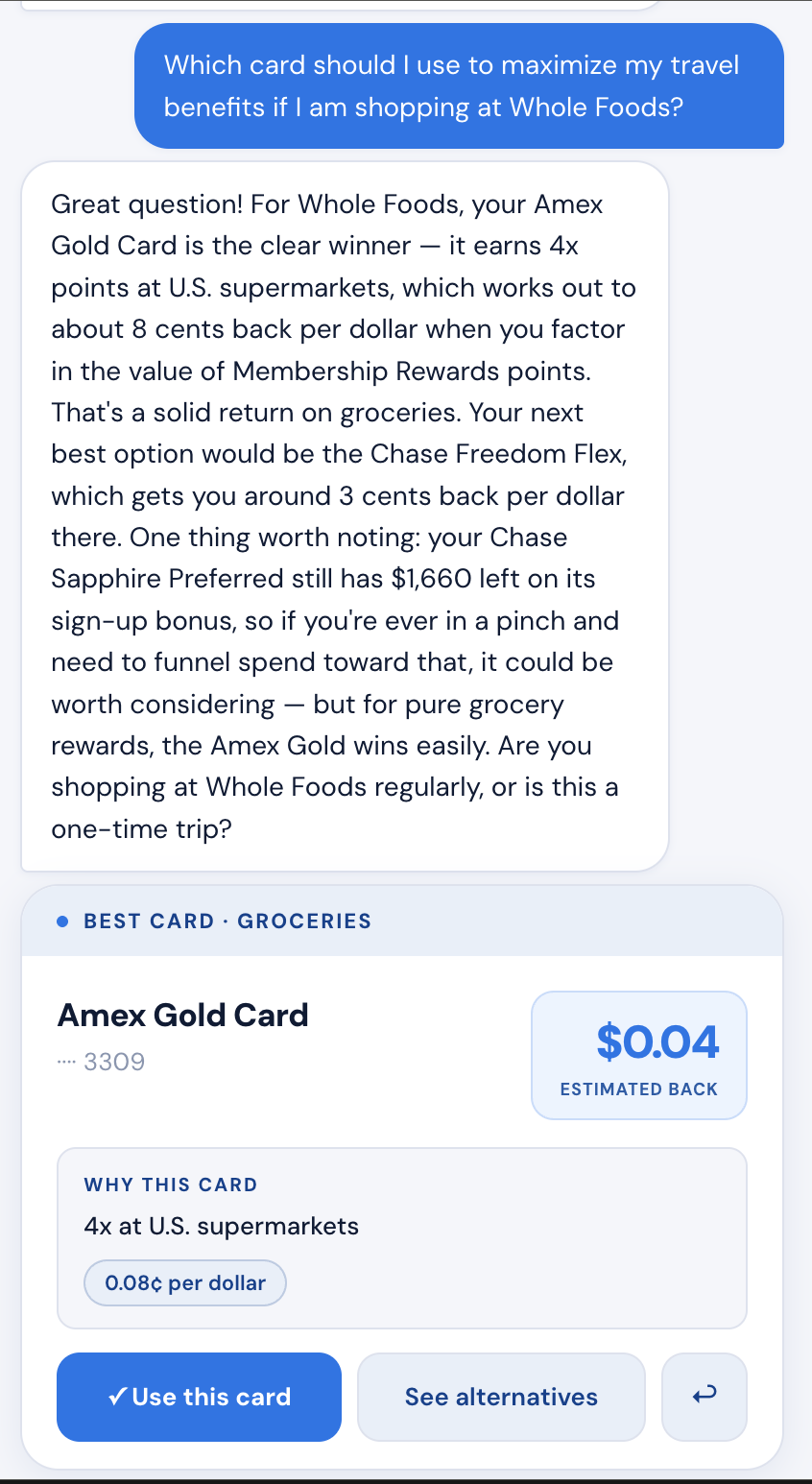
Before recommending a card, the AI asks what benefit type the user is trying to maximize (cashback, travel points, hotel rewards). Personalizes output without requiring account setup upfront.
Structured dialogue with escape hatches
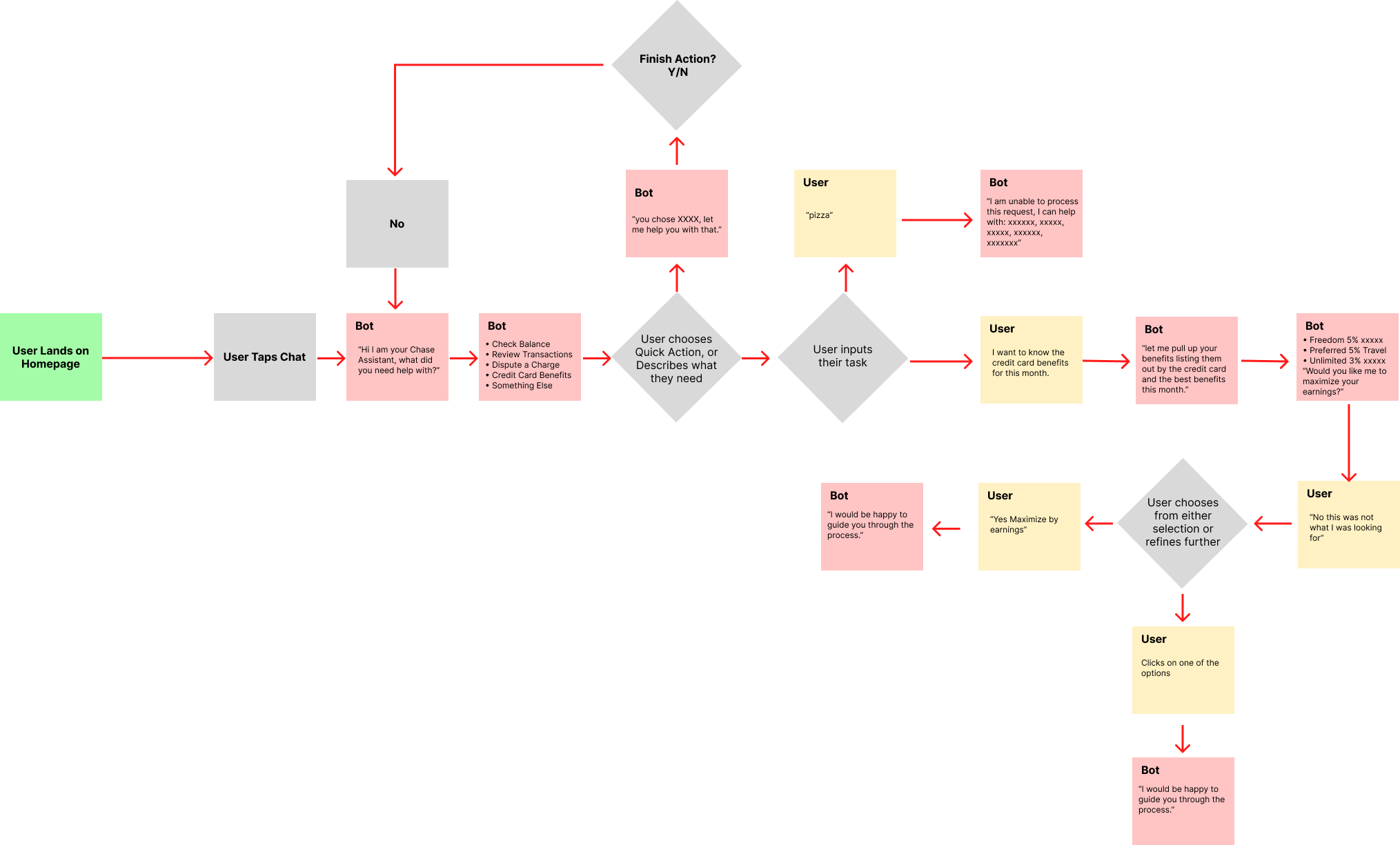
Conversational flows guide complex tasks step by step, but users can refine, disagree, or bail at any point. The system acknowledges unclear input, explains what it can't do, and redirects gracefully.
Recommendations, not decisions
Every AI output ends with a user confirmation step. The system never acts on the user's behalf without explicit approval — reinforcing trust and keeping humans in control of their finances.

Key Screens

Home / Entry Point
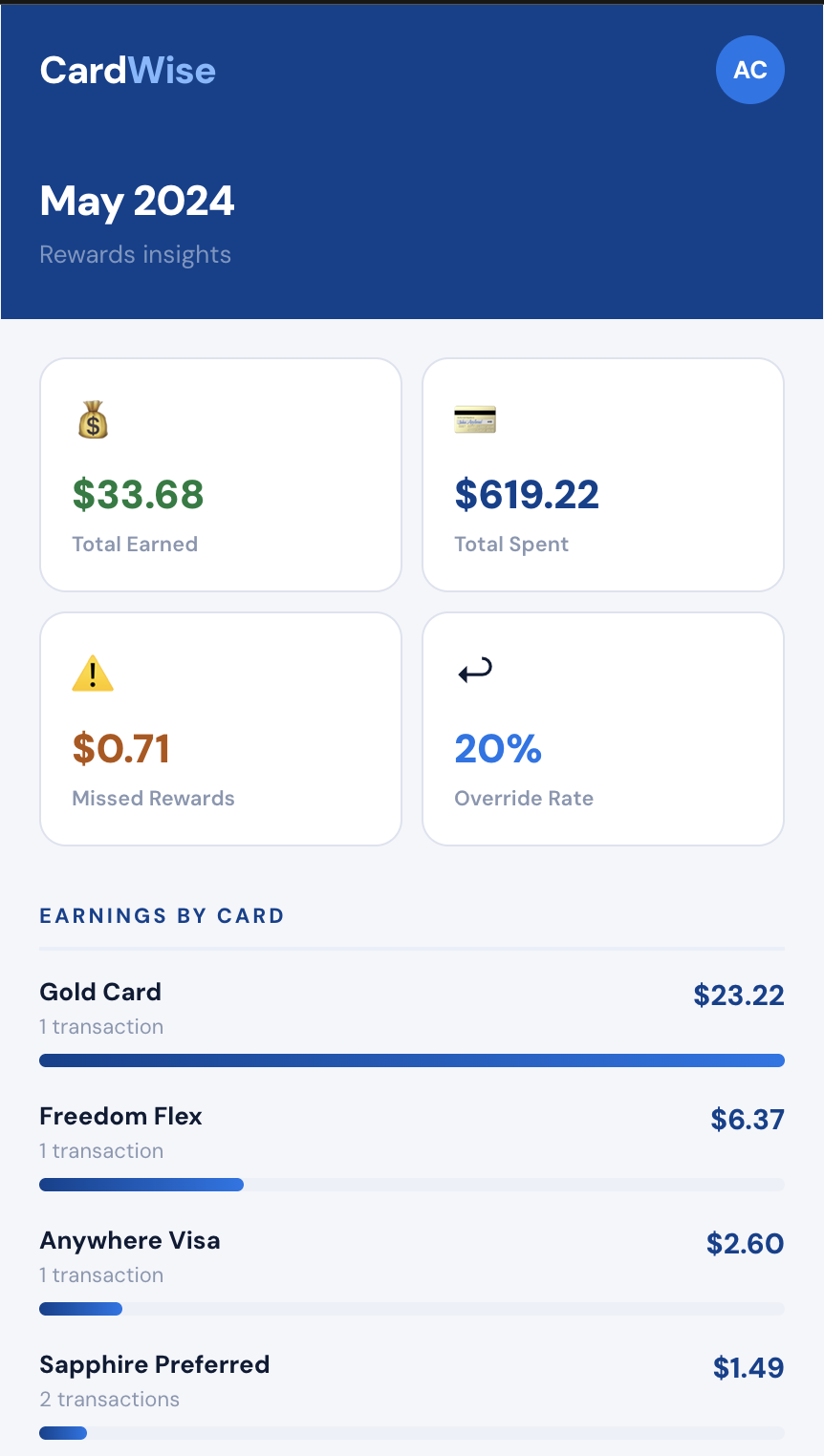
Goals & Insights
Recommendation Result
Home entry point screen
Goals and insights screen
Recommendation result screen

Dialogue Flow

Mapping every conversational branch — from entry point to task completion, with graceful exits at each step.

Dialogue flow diagram
Ethical Considerations

Risks accounted for in the design

Financial AI sits at the intersection of data privacy, economic inequality, and consumer trust. Each risk was evaluated and addressed through specific design constraints.

Privacy & data protection

Sensitive transaction data requires end-to-end encryption, minimal retention, clear opt-out, and transparent consent — especially for vulnerable populations.

Algorithmic inequality

Optimization tools risk amplifying advantages for premium cardholders. Mitigated by limiting recommendations strictly to user-owned cards and avoiding demographic profiling.

Automation bias

Users — especially younger or less financially confident ones — may over-defer to AI. "Why this card?" explanations, visible calculations, and mandatory confirmations preserve financial agency.

Outcomes & Reflection

What this project demonstrates

01

Ability to translate messy, fragmented user behavior into a clear problem statement and design opportunity.

02

Fluency with AI interaction model selection — choosing between agent, direct manipulation, and mixed-initiative based on user trust and cognitive load requirements.

03

Experience designing for sensitive, high-stakes domains — financial AI — where transparency, explainability, and human oversight are non-negotiable.

04

Ethical design thinking applied proactively: privacy, bias, and overreliance were considered before wireframing, not retrofitted after.

05

Pragmatic tradeoff reasoning: direct manipulation offers transparency, interface agents offer speed, mixed-initiative earns trust — knowing which to choose and why.

Live Demo

Try it yourself

The prototype below is fully functional — powered by a live Claude API call. It demonstrates the complete Mixed-Initiative flow: local scoring engine runs instantly, then Claude explains the recommendation in plain language.

Launch CardWise
Type a purchase, pick a goal,
get a live AI recommendation
Try it →
React · Anthropic Claude API · Mixed-Initiative interaction model
Local scoring engine + natural language explanation