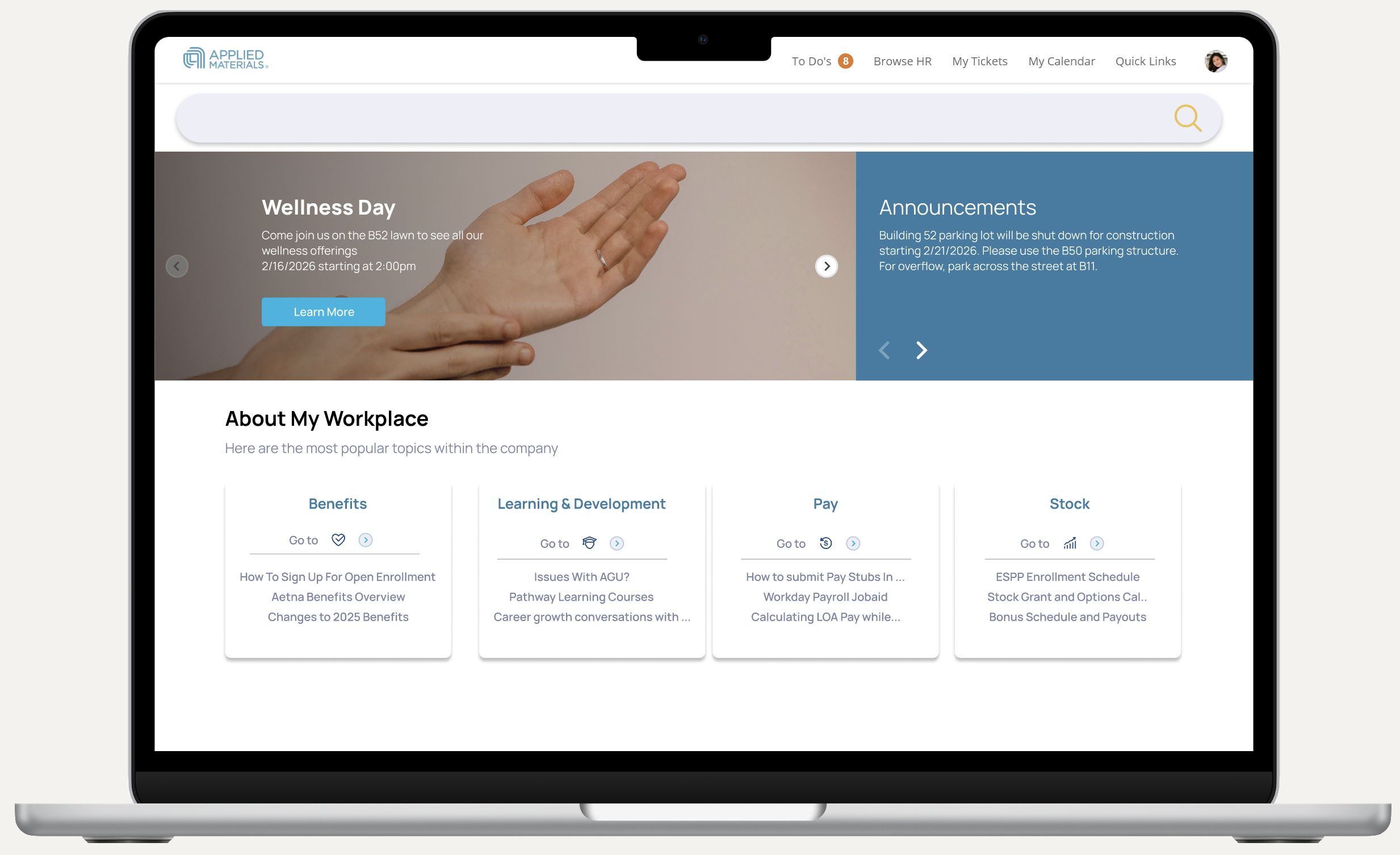
Applied Materials needed to redesign its fragmented HR experience for 36,000+ employees across 26 countries. Employees struggled with disconnected portals, inconsistent navigation, and outdated content, leading to heavy reliance on HR support. The project evolved from a portal redesign into a broader initiative focused on self-service and AI-powered employee support.
As UX Lead and later Product Owner, I led research, UX strategy, interaction design, and AI initiatives across the platform. I designed scalable self-service workflows, predictive-intelligence support tools, and helped launch an AI assistant in Microsoft Teams, improving search adoption from 3% to 95% while reducing HR dependency at scale. This project spanned 5 years and included 2 major portal design updates as well as an AI implementation.
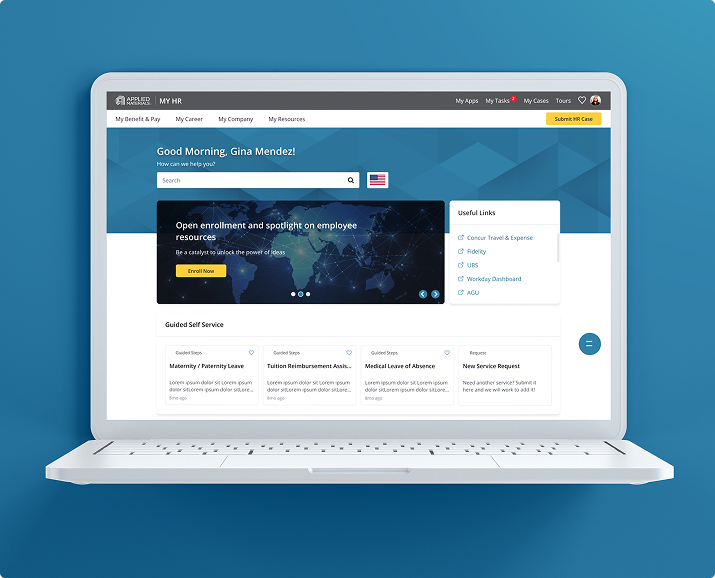
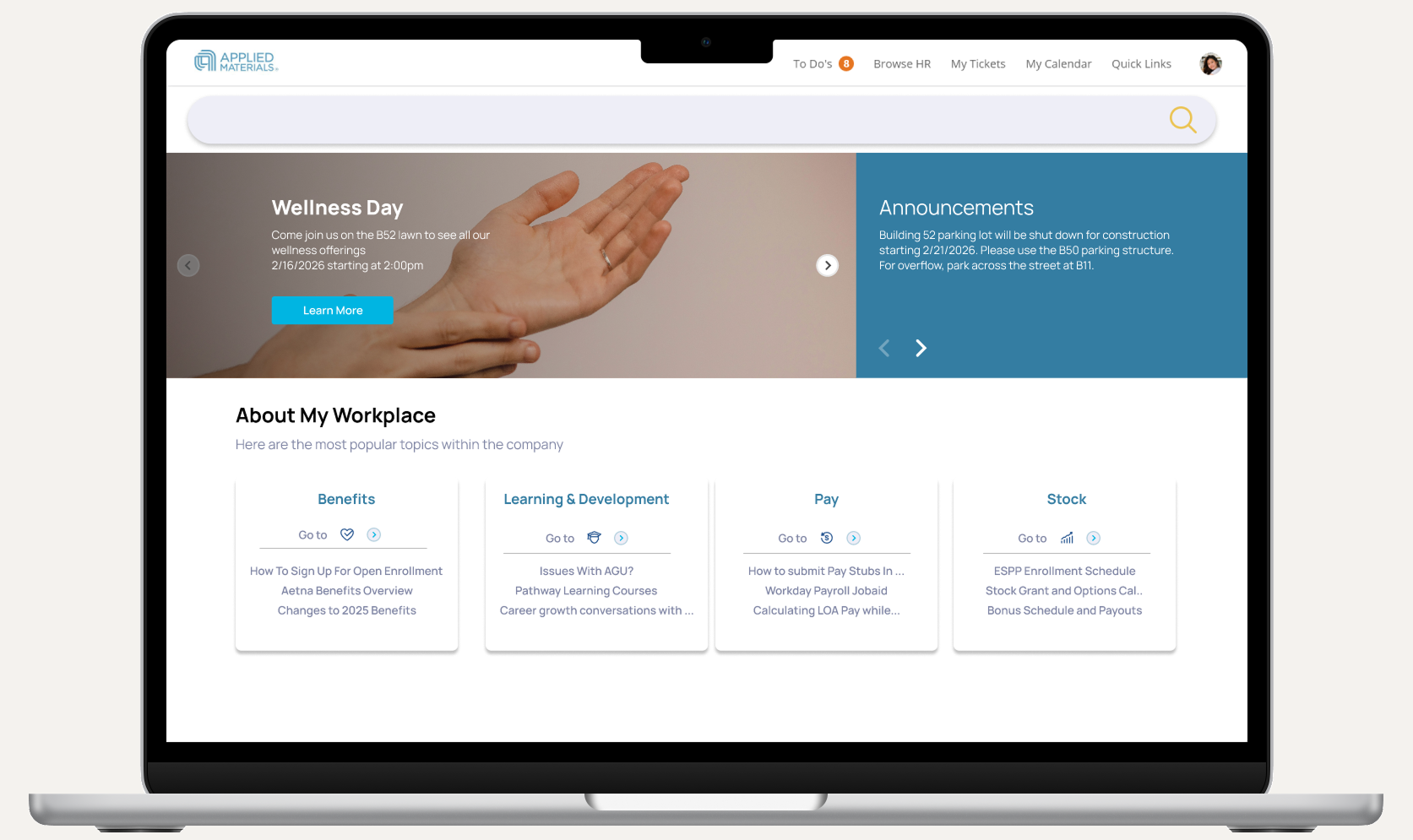
Final Portal Designs
96%Search Utilization
34%Reduced Tickets
+43NPS Growth
28%Time to Resolution
From the beginning of the project in 2020 I realized that the optimal user experience was to have one place for all employee digital experiences. What we were facing in HR was the same across all departments. To combat this, I coordinated with designers from IT to align our designs and started designing for the future — a single unified portal experience.
Gen AI Implementation
4.4★Star Rating
88%Output Accuracy
523User Upvotes
7minNavigation Saved
The Unified Portal is currently going through executive leadership buy-in. We want to continue to expand the platform to all departments and create a single digital experience for all Applied Materials employees globally.
Unified Portal
Future vision, under approval process
Deeper Dive
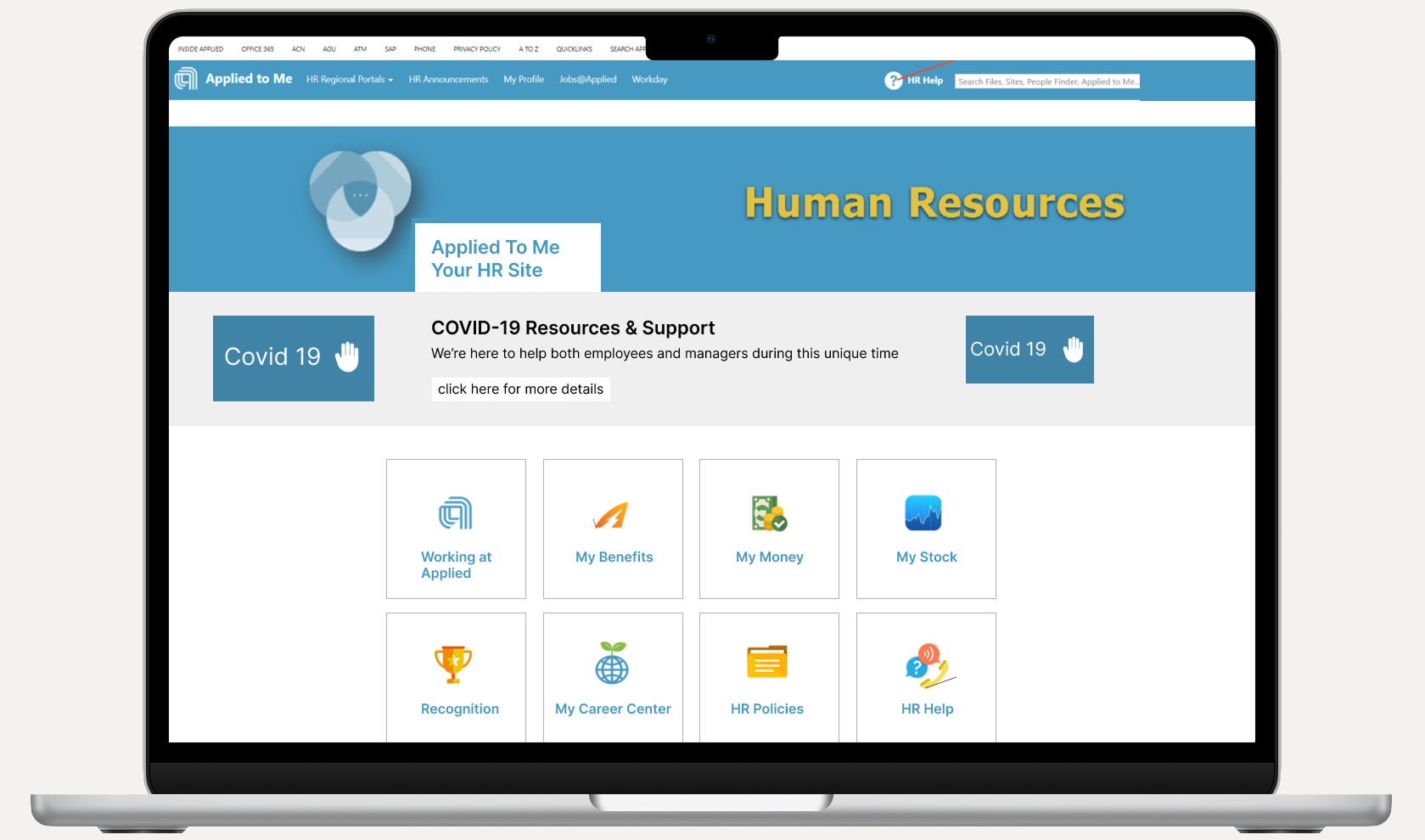
Phase 1 · 2020 – 2022Consolidation & Clarity
Context
25 portals. One company. No shared language.
30,000+ employees globally. Internal tools across HR, IT, Legal and Facilities all on ServiceNow — but spread across 25+ country portals with no unified navigation. Search utilization sat at 5%.
25+Country portals
5%Search utilization at start
2–3hrHR lost weekly to tier 0/1 questions
⟵⟶
Before← drag →Iteration 1
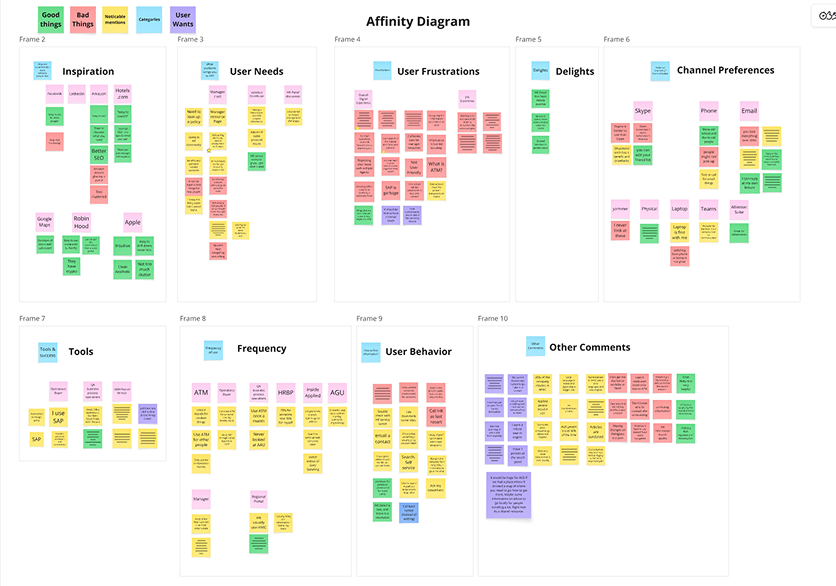
Research
Six methods. Four root causes.
Interviews, focus groups, surveys, ticket analysis, usage analytics, and A/B testing converged on the same problems: search wasn't trusted, navigation caused abandonment, and self-service couldn't scale culturally.
Trade-offs
Consolidate first. Personalize later.
We deliberately cut localized COE landing pages and per-persona features to stay focused on foundational consolidation — the work that would make everything else possible.
Focused on
Cross-site consolidation
Unified branding
Shared services modernization
Cut back
Localized COE pages
Per-persona personalization
SEO optimization
Iteration 1
One front door for HR.
All HR functions — Onboarding, Employee Engagement, Case Submission — under a single homepage with a Campaign Carousel, category sidebar, and unified search.
Iteration 2
Personalization and COE depth.
Unified taxonomy, personalized shortcuts, and dedicated COE pages. Smart Form consolidated 50 forms into one funnel — cutting routing time by 5 hours and reducing misdirected tickets by 72%.
Guided Self Service
Smart Form
Impact
26 portals → 1 platform.
26Portals unified
31%Search CTR increase
15%Fewer HR escalations
28%Faster ticket resolution
Phase 2 · 2023 – 2024AI Implementation
Why AI
Limits a portal couldn't solve.
Content required interpretation. HR bandwidth couldn't scale. Users needed to be met where they already were. Technology: ChatGPT + ServiceNow, delivered inside Microsoft Teams.
01Content Requires Interpretation
02HR Bandwidth Constraints
03Meet Users Where They Are
Decisions
Simplified IA over surface-level shortcuts.
Quick fixes would have compounded long-term complexity. We chose to simplify the information architecture and build governance frameworks — slower short-term, the right foundation for AI.
Strengths
Strong foundational IA
Clear user behavior data
Executive buy-in for AI
Weaknesses
Limited team capacity
Knowledge base not AI-ready
Change fatigue risk
Opportunities
Embed AI into Teams
Governance frameworks
AI-ready knowledge base
Threats
AI hype vs. readiness gap
Organizational stability
Vendor dependencies
AiMEE
An HR agent inside Microsoft Teams.
Deployed where employees already worked — answering HR questions in real time, without a portal visit. Designed around action-oriented outputs, measurable accuracy, and a trust-building metrics framework.
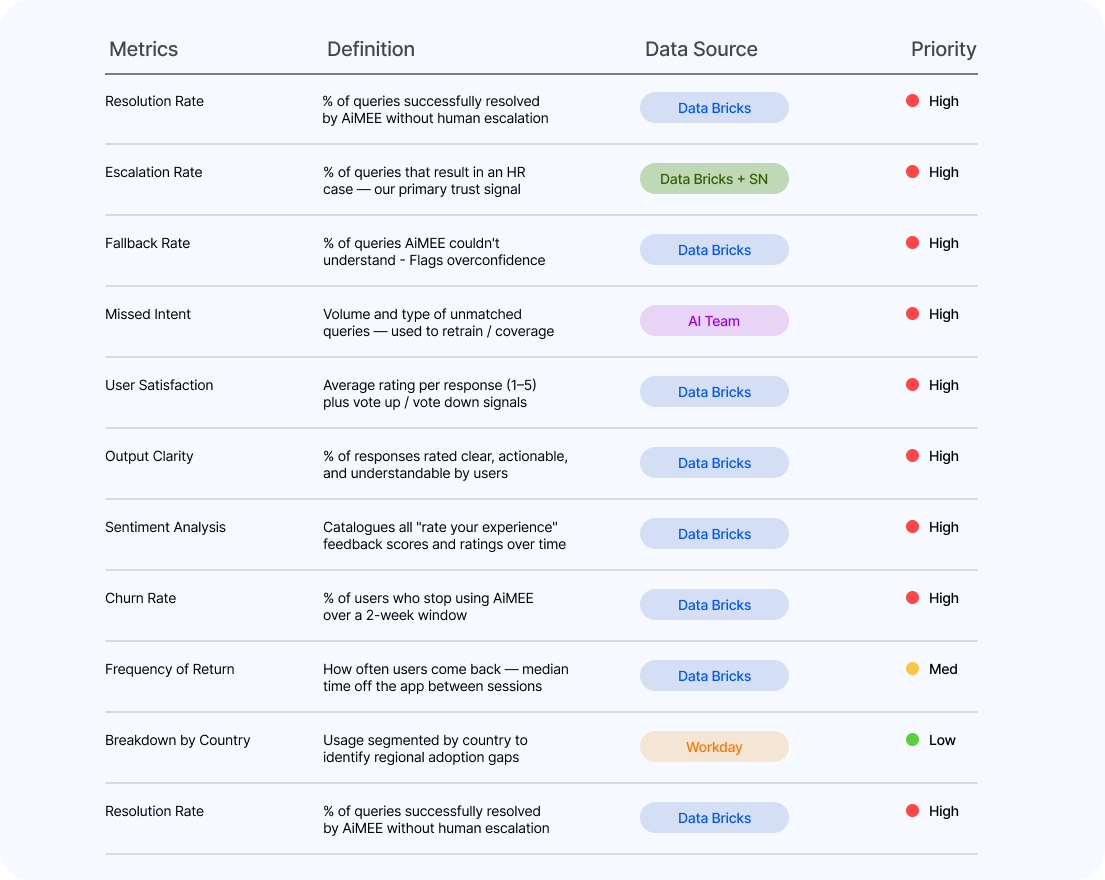
Metrics Framework
Defining what trust looks like in numbers.
The hardest part wasn't building the AI — it was knowing whether it was working. I designed a four-category framework to measure trust, usage, sentiment, and content quality across every interaction, then mapped every signal to a specific metric in the dashboard.
01
Trust Building
Star ratings, thumbs up/down ratio, rating distribution by question type and department
02
Usage
Active users, sessions per week, questions per session, return rate and adoption curve
03
Sentiment
Open-ended feedback synthesis, qualitative theme clustering, AI aversion signals
04
Content Quality
Knowledge base coverage gaps, broken reference links, content freshness and accuracy scores
Impact
4.43 stars. 88% clarity.
4.43★Average user rating
88%Output clear and actionable
523Upvotes vs 233 downvotes
What worked
Quick access right in Teams
Answers were clear and helpful
What needed work
Not all reference links working
No historical context learning
Phase 3 · In ProgressEnterprise Unification
The Problem
HR wasn't the only silo.
After five years of improving the HR portal, the same fragmentation appeared across IT, Facilities, Legal, Procurement, Travel, and Business Units. HR was still the catchall. The insight that had been forming since 2020 became the vision for Phase 3.
Vision
One door, many systems.
The Applied Materials Employee Center unifies HR, IT, Facilities, Legal, and Procurement under a single portal — addressing the root cause rather than optimizing individual silos. Currently in executive review.
ReflectionsWhat Five Years Taught Me
Conclusion
01Continued iterations may lead to an entirely different solution than the one you started with.
02Full product ownership — from road mapping to execution — compounds over time.
03It takes good data to train an LLM. Trust is the key factor. How you build it matters more than the model.
04Missed AI expectations cause aversion. Over-reliance without expertise is the opposite risk.
05Internal teams sometimes understand the problem better than outside consultants. Five years of context is a competitive advantage.